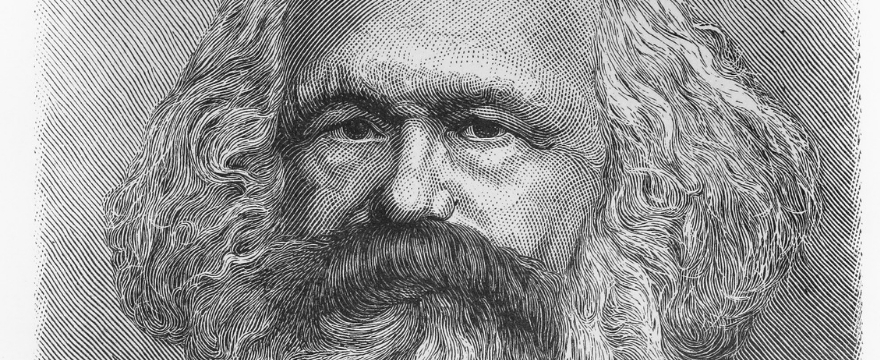
“A specter is haunting Europe—the specter of Communism…”
Thus wrote Karl Marx and Frederick Engels in 1848 in their ‘Manifesto of the Communist Party’. The specter turned a reality when the Russian Revolution took place. Soon it spread to China which became the ‘People’s’ Republic of China’ in 1949.
Karl Marx was one of the great thinkers who discovered some significant facts and revolutionized the thinking of man in certain aspects. His was a dynamic approach that led him to view economic matters in the historical perspective and other matters in the economic perspective.. His interpretation of facts was often unwarranted, his prescriptions too were wrong, but he was able to draw the people’s attention to the deficiencies, failings and evils of capitalism as no other could or did before him. His writings led to the establishment of an alternative order— socialism (though of the Communist brand.) So it is now possible (than when there was no alternative at all), to study the current economic theory and practice more objectively, deeply and critically. Hence Marx’s place in the field of economics and, naturally in the field of politics too, may be compared to that of Darwin in the field of biology and that of Freud in the field of psychology as a harbinger of a new era in human thought and civilization (though strictly on the scientific plane, as we shall see presently, he cannot compare with the noted scientists).
Admitting this much, we cannot admit Marxism as scientific. It is authoritarian, whereas science knows no authority save that of facts. The charges of revisionism, the claims of sole monopoly to the interpretation of what Marx said or meant, the divisions and deadly enmities among Marxists themselves, the frequent purges, the recantations, the intolerance of open criticism and free enquiry — all these (especially the word ‘revisionism’ itself) that have been the characteristics of Marxist practice — point out that Marxism is not a scientific theory, but a dogma. No one dared to openly criticize the official interpretation of Marxism in any of the former communist countries. No one dared differ even slightly from the official thesis and bring out facts that contradicted it. Such individuals – they were indeed very few – were immediately branded enemies of the people and shut up in prison or in a lunatic asylum with no hope of ever coming out as one was. The party men were no doubt allowed certain latitude in criticism within party meetings, but they were expected not to ventilate their personal opinions in public. Generally criticism should come from above and not from below. Once the party took a decision there was no further scope for criticism. Duty-minded people always go by the decisions when once they are taken by the majority _ unless they are contrary to all principles of decency and justice, but in the case of communists they are expected to follow not only the official line of action, but also the official line of thinking and give unless they are contrary to all principles of decency and justice, but in the case of communists they are expected to follow not only the official line of action, but also the official line of thinking and give up totally their own independent opinions and feelings. Dissent is simply not allowed. Everyone has to place his body and mind at the service of the politburo of the Party.